

Agile Methodology
- Agile methodology is a set of principles and practices for software development that prioritizes flexibility, collaboration, and delivering value to customers in an iterative and incremental manner. Agile approaches emphasize adaptability, customer feedback, and close collaboration between cross-functional teams.
Agile Principles
- Satisfy the Customer Through Early and Continuous Delivery of Valuable Software
- By shortening the time between documenting the project, reporting to your customer and then getting feedback, you can focus on the real goal of the project, which is delivering what the customer wants, not what you planned.

- By shortening the time between documenting the project, reporting to your customer and then getting feedback, you can focus on the real goal of the project, which is delivering what the customer wants, not what you planned.
- Welcome Changing Requirements, Even Late in Development
- Embrace change. Even when the customer requests a change late in the project phase, implement it.
- Why wait for another project to explore another iteration when you can do it now and get the results immediately? Agile wants you to stay nimble and on your feet so you can pivot without having to constantly reinvent the wheel.

- Deliver Working Software Frequently
- If you’re going to embrace change, then you’re going to have to give up on your etched-in-stone schedule, or at least create a shorter range to run your tasks. One way agile does this is by cutting out a lot of the documentation that is required with traditional project management when planning your schedule before you ever start a task. The trouble is a lot of that paperwork isn’t necessary. It only slows things down.
- You need to reach an agreement with your team and stakeholders to come up with an agile release planning that satisfies both parties.

- Business People and Developers Must Work Together
- It’s like they’re talking two different languages, and in a sense, they are, but both the business and developer sides of the project are crucial to its success.
- You must build a bridge between the stakeholders so they can understand each other and, as important, work together. Use the same tools you would manage remote teams to facilitate an exchange of ideas that both sides understand and are on board with.
- Build Projects Around Motivated Individuals
- In other words, don’t micromanage. It doesn’t work. It takes you away from what you should be focusing on. It erodes morale and sends talent packing. You assembled the best, now let them do what they’re good at. If you did the due diligence beforehand, then you can trust them to do the work. Of course, you’ll monitor that work, and step in as needed, but stay out of their way.

- In other words, don’t micromanage. It doesn’t work. It takes you away from what you should be focusing on. It erodes morale and sends talent packing. You assembled the best, now let them do what they’re good at. If you did the due diligence beforehand, then you can trust them to do the work. Of course, you’ll monitor that work, and step in as needed, but stay out of their way.
- Promote Face-to-Face Conversations
- Documenting conversations, creating email narrative streams and even using collaboration software like Slack, are all well and good. But when you’re trying to move swiftly, you don’t have time to wait for a reply. You need immediate answers, and the only way to achieve that speed of response is by talking to your team member or team in person.
- You can do this by working in the same physical space or having distributed teams. But if it’s the latter, you want to try and keep the schedules to the same hours, so you can at least video conference. That creates a more collaborative environment.

- Working Software Is the Primary Measure of Progress
- That means, is the software (or whatever product or process you’re working on in the project) working correctly? You’re not measuring progress by checking off tasks and moving across your scheduled timeline, but by the success of the software (or whatever) is the subject of your project.
- Basically, it’s staying focused on what’s important. The process is what gets you to achieve the goal of the project, but the goal of the project isn’t the process.
- Agile Processes Promote Sustainable Development
- One reason for short sprints of activity is not only that they lend themselves to accepting change more readily, but they also help to keep your teams motivated. If you’re working on a project for an extended period, there’s going to be burnout.
- It’s unavoidable. Don’t overtax your team with too much overtime. It’s going to impact the quality of your project. So, get the right team for the job, one that will work hard but not overextend themselves and put the project quality in jeopardy.

- Continuous Attention to Technical Excellence and Good Design Enhances Agility
- Whether you’re working on code or something more concrete, you want to make sure that after each iteration it’s improving.
- You don’t want to have to come back and fix things later. Fix them now. Better still, make sure they’re getting better.
- Use scrum, an agile framework for completing complex projects, to help review and keep the project evolving.

- Simplicity—the Art of Maximizing the Amount of Work Not Being Done—is Essential
- If you’re looking to move quickly through a project, then you’re going to want to cut out unnecessary complexities.
- Keeping things as simple as possible is a great ethic to streamline your process. You can do this many ways, including the use of agile tools that cut out the busy work and give you more control over every aspect of the project.

- The Best Architectures, Requirements and Designs Emerge from Self-organizing Teams
- When you have a strong team, you want to give that team the autonomy to act independently. This means they can adapt to change quicker.
- In fact, they can do everything with greater agility because you’ve given them the trust to act without second-guessing them.
- If you’ve done your job in collecting the right people, then they’ll do their job addressing issues and resolving them before they become problems.

- Have Regular Intervals
- Another benefit of creating a well-rounded team is that they will stop, reflect and tweak the way they do things throughout the course of the project. They don’t act by rote or just blindly follow protocol, but think through their relationship to the project and adjust when necessary.
- The last thing you want is a complacent team, one that stands on their laurels. What you need is an ever-evolving group that is constantly engaged and looking for ways to improve productivity.

Key Agile Concepts
- User Stories: The team divides the work into functional units known as "user stories" in consultation with the client or product owner. Each user story must add something valuable to the final product.
- Daily Meeting: The team meets every day at the same time to update everyone on the information necessary for coordination.
- Personas: When the project requires it, the team creates in-depth, fabricated biographies of hypothetical users of the intended product.
- Team: A small group of individuals assigned to the same project or effort, almost all of whom work full-time, is referred to as a "team" in the Agile context.
- Incremental Development: Agile teams prefer to use an incremental development strategy, which means that each iteration of the product improves on the one before it by including user-visible functionality.
- Iterative Development: Agile projects intentionally permit "repeating" software development activities and the potential for "revisiting" the same work products, known as iterative development.
- Milestone Retrospective: After a project has been running for a while, the team dedicates one to three days to examine the key moments.
How Does Agile Work?
- Define the project: The team, along with the customer, defines the project's goals, objectives, and requirements.
- Create a backlog: A backlog is a prioritized list of tasks that need to be completed. The customer, product owner, and the team work together to create the backlog.
- Plan the sprint: The team plans the sprint by selecting the highest-priority tasks from the backlog and determining how much work can be completed in the upcoming sprint.
- Execute the sprint: The team works on completing the tasks planned for the sprint, with daily meetings to check progress and address any issues.
- Review and demo: At the end of the sprint, the team demonstrates the completed work to the customer and gets feedback.
- Retrospect: The team retrospects on the sprint, discussing what went well, what didn't, and what can be improved for the next sprint.
- Repeat: The process is repeated for each sprint until the project is completed. The product is incrementally developed and delivered to the customer in small chunks.
- Continuously improve: Agile methodologies focus on continuous improvement. The team reflects on its progress and makes adjustments as necessary to improve processes, tools, and communication for the next sprint.
Agile Meetings
- Sprint Planning Meeting: During sprint planning, the team and Product Owner discuss and select items from the product backlog to work on in the upcoming sprint. They also agree on a sprint goal.
- Daily Standup (Daily Scrum): In the daily standup, team members briefly share updates on their work. They discuss what they accomplished yesterday, what they're planning to do today, and any obstacles they're facing.
- Sprint Review: At the end of the sprint, the team presents the completed work to stakeholders. Feedback is gathered, and the product backlog may be adjusted based on the discussions.
- Sprint Retrospective: The retrospective is a team reflection on the sprint. Successes and challenges are discussed, and process improvements are identified for the next sprint.
Agile Practices
- User Stories: User stories are concise descriptions of desired functionality from the end-user's perspective. They help define requirements and guide development.
- Iteration (Sprint): Iterations, often referred to as sprints, are fixed-duration development cycles. They allow for regular feedback and adaptability.
- Continuous Integration (CI): CI involves frequently integrating code changes into a shared repository. Automated tests ensure that code remains functional.
- Test-Driven Development (TDD): TDD is a practice where tests are written before writing the actual code. This helps ensure that the code meets the desired functionality.
- Pair Programming: Pair programming involves two programmers working together on the same piece of code. It enhances code quality and knowledge sharing.
Advantages of Agile
- Collaboration and Interaction: Agile fosters extensive collaboration and interaction between the client and the project team. This leads to improved transparency for clients and a clearer understanding of project phases.
- Enhanced Transparency: Clients benefit from increased transparency, gaining a better insight into the project's various stages.
- Predictable Delivery: Agile often results in the predictable and sometimes even early delivery of the product.
- Predictable Cost: Agile projects adhere to a rigid schedule, making project costs more predictable.
- Flexible Changes: Agile methodologies allow for changes to be refined and reprioritized within the product backlog.
- Effective Prioritization: Clients can prioritize different features, enabling the team to maximize project value.
- Incremental Development: Agile breaks down the project into smaller units, leading to higher-quality development, testing, and collaboration.
These advantages collectively contribute to the success and efficiency of Agile projects.
Disadvantages of Agile
- Scope Creep: Agile's flexibility can sometimes lead to scope creep, where project requirements expand beyond the initial scope.
- Requires Skilled Team: Successful Agile implementation relies on a skilled and experienced team, which might not always be available.
- Lack of Predictability: The iterative nature of Agile might lead to uncertainty about project timelines and outcomes.
- Client Involvement: Constant client involvement can sometimes slow down decision-making processes.
- Documentation Challenges: Agile's focus on working software can lead to less emphasis on comprehensive documentation.
- Adaptability to Change: While Agile is designed to embrace change, some projects might struggle to adapt to frequent changes.
- Dependency on Customer Availability: Agile requires active participation and availability of the client, which can be challenging in some cases.
When Should You Use Agile Project Management?
- Agile is a project management approach that is better suited for ongoing projects and projects where specific details are unclear from the beginning because of its core principles, which include continuous delivery, iteration, adaptability, and short time frames, among others.
- Therefore, an Agile approach is a good choice for a project lacking precise constraints, deadlines, or resources.
The Waterfall Model
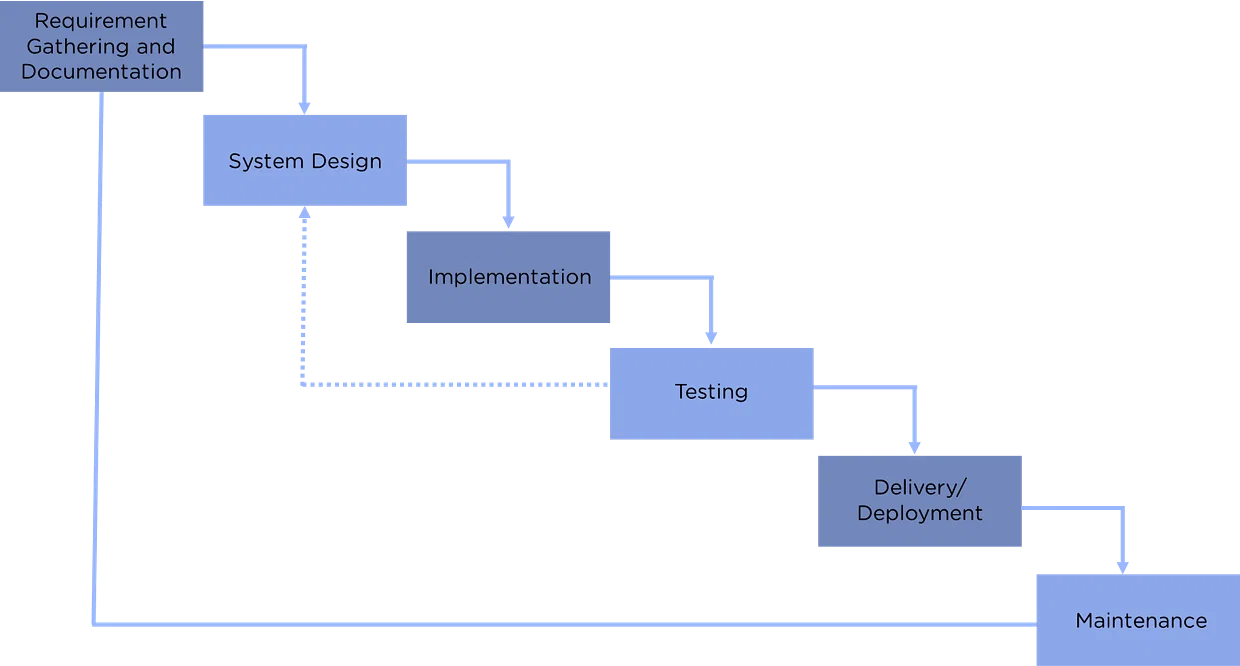
The waterfall model is an earlier approach used for software development. It involves teams following a step-by-step process, only proceeding after the previous steps are completed. Each phase needs to be completed before the next phase can begin.
Steps of the Waterfall Model
- Requirement Gathering and Analysis: All the system requirements that need to be developed are collected in this phase and documented in a requirement specification document.
- System Design: The requirements from the previous phase are studied, and the system design is set up. The system design helps specify the hardware and the system requirements. It also helps define the system's architecture.
- Implementation: Based on the system design, small programs called units are developed. These units are integrated into the next phase of the process. Each of these units is developed and tested for their functionality; this process is called Unit Testing.
- Integration and Testing: After each unit is tested, it is integrated into a system. After this, the entire system is checked for faults and failures.
- Deployment of System: Once functional and non-functional testing is completed, the customer environment is given access or released into the market.
- Maintenance: To handle issues that come up in the client environment, patches are released. Maintenance can also help enhance the project and deliver changes to the customer environment.
Using Agile and Waterfall Methodologies
- Not all projects neatly fall into one of the two categories.
- An Agile-Waterfall hybrid approach can make sense for projects that could benefit from aspects of both a traditional approach and an iterative approach.
- It could imply, for instance, that planning and design get done using the Waterfall method while development is via Agile's short development cycles.
The Waterfall Model’s Disadvantages
- Working software isn’t created until late in the project life cycle
- There’s a large amount of risk and uncertainty
- Not suited for complex and object-oriented projects
- It is unsuitable for long and ongoing projects
- Measuring the progress within stages is difficult
- Changing requirements cannot be accommodated
- The end-user/client isn’t focused on
- Testing is delayed until the project is completed
Advantages of Agile Over Waterfall
- Flexibility: Agile offers the flexibility to make changes to the software even during the late stages of the SDLC.
- Enhanced Collaboration: Agile enables more collaboration with clients, ensuring higher levels of customer satisfaction.
- Continuous Delivery: Developers can ensure the continuous delivery of working software instead of being stuck in a particular phase.
Scrum
- Scrum is a popular framework that enables teams to work together. Based on Agile principles, Scrum enables the development, delivery, and sustenance of complex projects.
- It enables teams to hypothesize how they think something works, try it out, learn and reflect from their experiences, and make appropriate changes.
Members of a Scrum Team
1. Product Owner:
A Product Owner is an individual responsible for understanding customer/client needs and determining the business value of those requirements. They must be able to:
- Maximize ROI by determining and prioritizing product features.
- Focus on what needs to be accomplished in upcoming sprints.
- Make decisions required to complete the project and manage the project backlog.
2. Scrum Master:
The Scrum Master helps teams learn and apply Scrum concepts to achieve business value. They ensure that the team is accountable for achieving the organization's business goals by:
- Removing impediments that hinder team productivity.
- Assisting the team in adopting Scrum methodologies.
- Organizing critical Scrum events and meetings.
3. Scrum Team:
- The Scrum Team is a group of individuals that collaboratively work together to deliver stakeholder and client requirements.
Scrum Artifacts
Scrum artifacts are essential components of the Scrum process. These artifacts enhance transparency and the team’s understanding of their work. The three main artifacts are:
1. Product Backlog
- The product backlog is a comprehensive list containing new features, changes to existing features, bug fixes, infrastructure modifications, and other items necessary for fulfilling specific requirements.
- It serves as a repository for all the work that the team will engage in.

2. Sprint Backlog
- Before delving into the sprint backlog, let's clarify what a sprint means.
- A sprint refers to a time frame within which a team accomplishes a designated task. Sprints enable teams to deliver tangible results at the conclusion of each sprint, usually lasting one to four weeks.
- The sprint backlog is a subset of the product backlog that encompasses tasks intended for completion in order to achieve goals determined through discussions between the product owner and the team. Tasks are extracted from the product backlog and incorporated into the sprint backlog.

3. Product Increment
- The product increment constitutes a compilation of all the tasks associated with product backlog items that were completed during a sprint, as well as the cumulative value of earlier sprint increments.
- Increments denote tangible and functional output produced by the end of a sprint. They represent progress toward the organization's overarching objectives. The outcome must be in a usable state, even if the decision to release is deferred by the product owner.

Scrum Framework
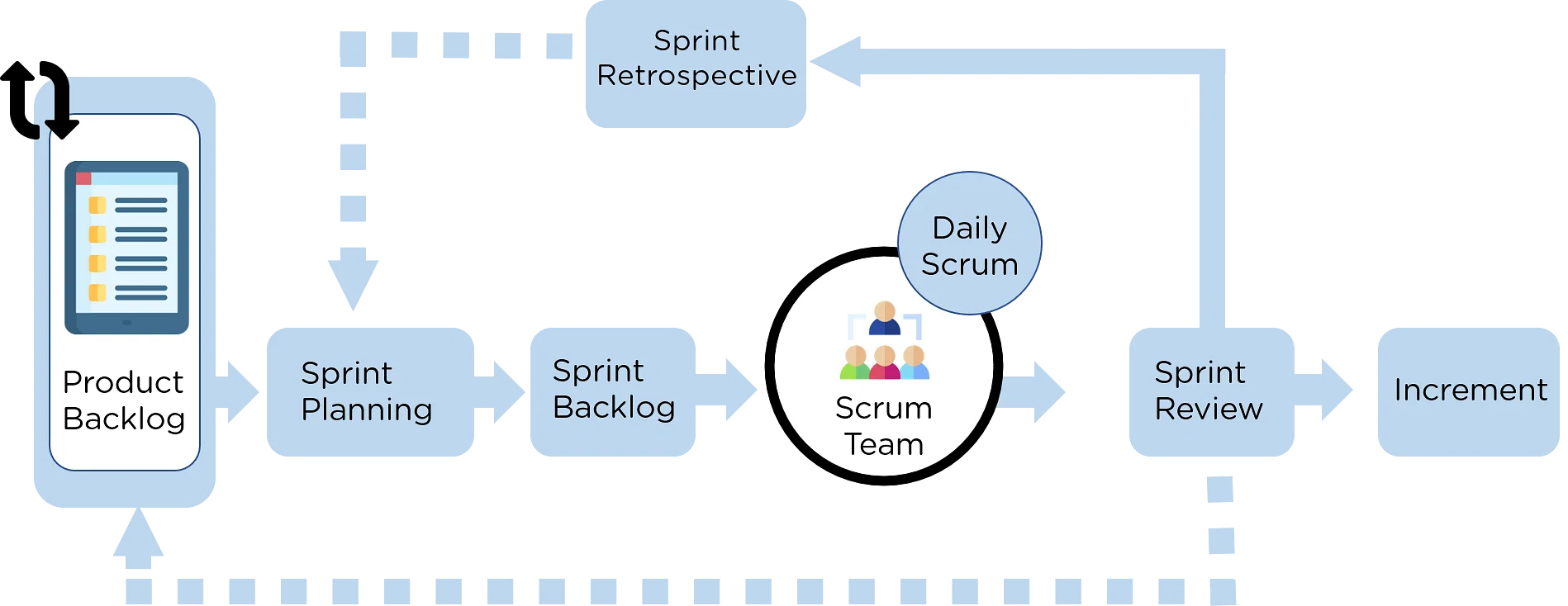
1. Sprint Planning: During this stage, the team determines the tasks from the product backlog that they want to work towards completing during the sprint.
2. Sprint Backlog: The tasks discussed during the sprint planning are added to the sprint backlog.
3. Scrum Team: The Scrum team (usually consists of 5 to 9 members) works on the tasks mentioned in the sprint backlog.
4. Daily Scrum: The team will have daily Scrum meetings, which are 15-minute sessions, during which the team members synchronize their activities and plan their activities for the day.
5. Sprint Review: After a sprint is completed, a sprint review takes place. Involving the team, scrum master, product owner, and stakeholders, the sprint review shows what the team accomplished during the sprint. During the meeting, questions are asked, observations are made, feedback and suggestions are also given.
6. Product Backlog: At this point, the product owner presents the product backlogs to the stakeholders for suggestions for tasks that can be added in the upcoming sprints, and so on.
7. Sprint Retrospective: After the sprint review, the sprint retrospective takes place. During this meeting, past mistakes, potential issues, and new ways to handle them are identified. Data from here is incorporated when planning the new sprint.
Scrum Board
- The Scrum board is a physical/ virtual tool that helps the team visualize items that are part of the sprint backlog.
- It shows all action items that need to be completed during the sprint, keeping the team focused on the task they must complete during the sprint.
- The board is present in a place that’s easily accessible to all team members and can be either physical (whiteboard/ stickers) or virtual (software tools).
- The board is divided into slots like to-do, in-progress, and done. When the new sprints are started, the board is reset, and a new board is created.
Note
Remember that Agile is flexible and can be adapted to suit your team's needs. Regularly assess and adjust your practices for continuous improvement.
Kanban
- Kanban is a project management method that helps teams get work done efficiently. It's like a visual to-do list that makes sure everyone knows what to work on and when.
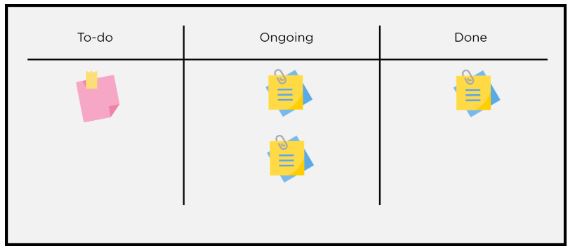
- Visual Boards: Kanban uses boards to show tasks and their progress. Imagine sticky notes moving from "To Do" to "Done" columns.
- Limited Work: Teams limit how many tasks they work on at once. This stops things from getting too crowded and helps tasks move smoothly.
- Take What You Need: Tasks move forward only when there's space, avoiding jams in the process.
- Getting Better: Teams regularly check their process, find problems, and make things work better.
- Fits Anywhere: Kanban works with different jobs and teams. It doesn't force big changes.
- Smooth Flow: Kanban focuses on keeping tasks moving, making customers happy.
- Small Changes: Instead of big changes, Kanban prefers small, step-by-step improvements.
- Cards Talk: Tasks are shown as cards, making it clear what needs to be done.